Monday, October 31, 2005

Rosa Parks

Some mornings when I sit down with the paper, there is news that makes me cry a little bit. That’s what happened last week when I read that Rosa Parks had died. I read the articles, thinking about all I had learned about her as a child, and then as a teaching assistant in an undergraduate course on the civil rights movement. I thought about writing something about her and what she means to me—something about the power of individuals to make a difference, about the importance of standing up (or sitting down) for one’s beliefs, about what finally drives people to act against injustice.

But the main memory that kept coming back to me was sparked by the mention of E.D. Nixon, a leader of the NAACP in Alabama, who Rosa Parks had called after her arrest, and who helped organize the bus boycotts in Montgomery. His name had been on the list of people and events that students in the class I was a TA for had to identify on the final exam. While I didn’t do any statistical analysis, I think that was the one that my students got wrong the most. But they didn’t decide to leave that one blank, but took a guess. Most wrote that he was the president who resigned after the Watergate scandal. Did they not know what President Nixon’s first name was? Did they not know how to spell Richard? I suppose they were just taking a guess, hoping for the best. There was one answer that really stood out to me, though, something to the effect of:

“E.D. Nixon was the governor of California when the Black Panthers stormed the state Capitol with automatic weapons. He later became President of the United States, but was forced to resign because of Watergate.”

Fabulous: mix up a couple of people irrelevant to the question, bring in and exaggerate an event that had nothing to do with the man you are identifying, cross your fingers, and hope for the best. I called up the other TA and read her the answer. (That’s right, when you said silly things in your papers and exams in college, your TAs were sharing and laughing at you.)

Because that was all I could think to write, I didn’t write anything.

As soon as we read that Rosa Parks would lie in state in the Capitol rotunda, The Husband and I decided that we had to go.

We arrived at the Capitol South Metro station a little after 5, and followed groups of people out toward the Capitol building. I had read that the funeral procession would arrive at 5:30, and that the viewing would begin at 6:30. We approached a guard and were directed down to 3rd Street. We cut in at 1st Street, along with everyone else, thinking we had found the end of the line. Then we followed that line all past the reflecting pool, down onto 3rd, and then saw it wrap back around the other side of the pool. We felt triumphant as we settled in at the end of the line to wait. The line was moving, but we realized quickly that we were moving because they were setting up lines to snake people back and forth, and we were filling in that space.

Soon we were back on 3rd Street, and were only shuffling along in the line. It was chilly, but not too cold. The blue of the sky behind the Capitol was deepening, while in the opposite direction the sky behind the Washington Monument was lit with pale gold, although the sun had already sunk below the horizon. I studied the Capitol dome, glowing bright white against the darkening sky. I remembered the first time I’d visited Washington, three and a half years ago. We took a shuttle from BWI to the home of some friends who live in Alexandria. The driver was chatty, and tried to engage all his passengers in conversation—I remember him asking a van full of strangers who they believed was at fault for the problems in Israel. After dropping off a few passengers in the District, the shuttle turned a corner, and I saw the Capitol dome lit up against the sky. My excitement made the driver realize I had never been in Washington before, and he was excited to show me more. To what I’m sure was the dismay of an older couple who just wanted to get to their hotel, the driver took a route that would give us a view of the White House, before getting lost on our way to our friends’ house. But more than the White House, I remember that first glimpse of the Capitol. I remember my awe at seeing the dome all lit up at night for the first time, and it still impresses me. I like to say that when I get tired of seeing the dome at night, it will be time for me to leave Washington. I spent a lot of time looking at it last night, and I don’t think I’m tired of it yet.

People became friendly in the line, striking up conversations with strangers. A group of people somewhere behind us spent some time singing—“He’s Got the Whole World in His Hands,” “Jesus Loves Me,” “The Star Spangled Banner.” A little boy behind us, probably about three years old, was a bundle of energy running up ahead to give high fives to a man a few yards ahead of us whom I’m sure he didn’t know, then back to his mom, over and over again. I had brought a book, but even with the lights along the lawns, it was difficult to focus enough to read.

We wondered what was going on, and The Husband suggested I call our friend Jeff, and ask him to check on the Web or on television to see if there was any news of what was happening. It was nearing seven and the line was no longer moving very much. My feet and calves were starting to ache. Eventually, I decided to call Jeff, but didn’t get an answer. I thought about trying to call someone else, but finally, a little after seven, we saw the flashing lights of the motorcade approaching along 3rd Street. Cheers went up throughout the crowd as buses rolled by—first the empty 1957 bus, then several full Metro buses full of Mrs. Parks’ family and friends. I stood on tiptoe, trying to peer over the top of the crowd, and saw people waving in the buses.

After they had passed, I turned to The Husband. “You know, given my experiences taking Metro bus on my commute, I suppose I shouldn’t be surprised that they’re late getting here.”

Still, the line didn’t move. A woman in front of us called her father in New Hampshire and asked him to turn on the television. From him, we found out that the casket was being carried in to the Capitol by an honor guard, and that Bush and some congressmen were there for a ceremony. We were told that the cameras were turned off in the rotunda for a prayer. The woman’s father said he would call back if there was any more information.

Our line crossed over onto another lawn. We felt that we were making progress. The singing groups started up again, this time with “Joy to the World.” At last we could see people moving up onto the steps of the Capitol.

At 9:45 we were out of the line that snaked back and forth. Someone asked the guard who was letting us out how much longer she thought we would have, and she speculated it was an hour. I wanted to believe her, but I thought she was probably just making up an answer. As we followed the edge of the reflecting pool closer to the security point, we realized how chilly it was. We were exposed to the breeze now, and didn’t have a crowd around us to help keep us warm. In exchange for losing our warmth, though, there were occasional benches and curbs to sit down to rest our feet. After five hours of standing, it was nice to give my legs even a quick break.

Moving up hill towards the security checkpoint, I heard the little boy behind us, now in his stroller, say, “Mommy, are you okay?”

“Yes, I’m okay. Are you okay?”

“I’m okay. Mommy? What are you doing?”

“Freezing!” People around us laughed. It was an hour since we’d been told that we had an hour left to go. Another guard told us it would be another forty minutes, and assured us that Metro was staying open until one.

Twenty minutes later, just past 11:00, after going through the metal detectors, we climbed up the steps and walked around to the west of the Capitol, looking down towards the lines that we had been in all evening. We couldn’t see the end of the line, but we could tell it was even further away than when we’d first started. We walked slowly looking out over the Mall. The Washington Monument towered beyond the lines of people, and just beyond that, I could see the arches of the World War II Memorial. At the end of Mall, the Lincoln Memorial was also lit up, and I thought of Martin Luther King giving his speech there more than 40 years ago. I thought about him suddenly being asked to take a leading role in the boycotts after Rosa Parks’ arrest only a few years before that. I wondered if he would ever have imagined her receiving this honor.

We were no longer behind the people we had been waiting in line with. Instead we followed a couple and their son up the steps. The boy was a miniature version of his father, formally dressed in a suit, a long overcoat, and a hat. The men were asked to remove their hats has we entered the building, and everyone lowered their voices.

As we entered the rotunda there were ropes guiding people in a circle, and as we passed a guard, I at last saw the deep shine of the small casket. We paused as we reached the far side of the casket. I watched more people file in. In whispers, people thanked Rosa Parks as they made their way around; some were crying; a woman crossed herself. I remembered to look up into the dome just as we left. As we moved back down the marble steps, I realized that I hadn’t noticed any of the paintings or statues. The small casket had been the only focus.

We emerged from the Capitol and made our way slowly down the steps, looking out over the crowds of people and the view of the Mall once more. When we reached the bottom of the stairs, we quickened our pace and headed home, wondering at the number of people that remained. The line stretched far beyond where we had joined it six hours before, looping around corners, and we couldn’t tell where it ended.

I am glad I went. I am pleased that Rosa Parks was honored in such a formal way. I am grateful to have had the opportunity to pay my respects to an important woman. I am moved by the murmurs of thanks from people of all different backgrounds. But I think the most important part of the evening was the wait in line. My feet hurt and my legs ached after six hours of shuffling through a line. But it was important to see the crowds that turned out, to feel that I was a part of something, to understand how much one woman symbolized to so many people.

Wednesday, October 19, 2005

Washington moment

I was walking down M Street after work yesterday when my dad called. A few minutes into the conversation I had to ask him to hold on for a moment: I couldn’t hear him for the sirens that were approaching. Two police cars moved through the dregs of rush hour traffic slowly, sirens screaming, followed by a limousine, a black SUV with men in sunglasses watching out the windows, and then another police car. When they had passed and moved far enough along the block, I brought my phone back to my ear.

“Sorry,” I said. “Just a little motorcade. How was your trip?”

Saturday, October 15, 2005

Italy

Yesterday on my commute home, I thought of something I wanted to write down, and reached into my bag for the little notebook I make a habit of carrying with me. When I flipped it open, I saw that it was the notebook I’d used in Italy in May and realized that I’d never written anything after the trip. I read through it, remembering where I’d been sitting as I wrote on each day. The Husband and I were in Italy for about ten days, but the notebook really only covers five in any detail. We’d spent the first few days in Rome, and when we arrived in Florence to meet up with friends, I think I lost interest in using my down time for journal writing and spent it talking with Becca and Alex instead. After the first five days, my notes are very quick, and there are lists of things to do and restaurants to try that aren’t necessarily in my handwriting, as I would sometimes hand the notebook to my friend Becca to jot something down.

What surprised me when I was reading through the notebook was how much I’d already forgotten. I remember the piazzas we sat in and the churches and museums we saw. I remember how much I loved the old, winding roads of Rome, and that I felt desperately aware and happy that I was finally in the city I had wanted to see for so long. I remember walking along the Arno on cool, quiet mornings, and feeling hot and tired at the end of our trip as we climbed up a hill toward Piazzale Michelangelo for a view of Florence. I remember that I ate pizza and gelato every day, and that we laughed a lot with our friends, sitting on benches in piazzas around Florence. But there are lots of little things I had forgotten:

As we descended into Florence, I was struck by how much the landscape reminded me of California, and my wonder at the similarity continued as we watched out the window of the bus that would take us to the train station. The hills looked more like the ones in California than those that I see on the east coast, and the houses had the red tiled roofs that I miss on the Spanish-style houses at home.

We decided to save some money by taking the slower train to Rome, which according to our guidebook would take less than three hours. Unfortunately, we bought tickets for an even slower train that the book indicated, and by the end of the ride, our jet lag was beginning to hit. I was fighting sleep, knowing I needed to force myself onto a regular schedule, but since I couldn’t be active or get a lot of fresh air, it was hard.

At Arezzo, as we pulled into the station, there was a lot of yelling and drumming and chanting. People pounded on the train as it slowed to a halt. Then our car was full of rowdy soccer fans, many of them wearing t-shirts that said “Perugia Ti Odio.” The group was wild—shouting and singing and chanting, while they drank beer out of plastic water bottles and smoked cigarettes into which they’d mixed a little bit of pot. The car was hot and began to smell with all the smoke and bodies. Some of the men took of their shirts: one was extremely hairy; another had a back covered in pimples. The couple that sat across from us were a little less enthusiastic. Neither spoke English, but the young woman spoke Spanish, so we managed conversation, and she explained that there was a big rivalry between Arezzo and Perugia. The whole thing was amusing to watch, but it was a relief when the fans reached their destination. It was even more of a relief when one of the conductors passed through the car and moved us into one with air conditioning and without the smells that the fans had left behind. We were able to get comfortable and relax, and we watched an almost full moon rise above the hills to the east.

I can’t really comprehend the age of things here. How can I get my mind around the idea of something being 2,000 years old? But I love that there are new flowers growing in the crevices of such ancient stones.

We sat along a bench in Rome’s Piazza Farnese, to get out of the sun and rest our feet, along with other people, mostly Italians eating lunch. There was a little boy who purposely knocked over his soda. After his mother scolde him and cleaned it up, he yelled “Bambina!” to a little girl who is chasing pigeons, followed by something in Italian that I couldn't understand. She ignored him.

When you climb into the dome of St. Peter’s, you are right against the mosaics. You can actually touch them. I was glad, but I felt as though I were getting away with something I shouldn’t.

I love Michelangelo’s Pieta. I felt very separate from it. At first I thought that was because of all the people and the glass. But the separateness was deeper than that. I think it is something about Mary’s face.

We went into the foyer at the Santa Maria church in Trastavere. There was something happening inside, maybe a service, maybe a concert, so we just stood in where we were and listened to the organ and the choir. There was a small window in the door, but I wasn't tall enough to see through it. Outside the church there was a skinny, bent old woman begging. With her shawl and her cane she seemed like something out of a movie. I gave her a few coins.

We wandered through Trastavere reading restaurant menus, trying to decide where to have dinner. Our mind was made up for us when there was a sudden downpour. We went into the nearest restaurant, one I'd be skeptical of only a few minutes before. Things were hectic for a few minutes, as everyone who had been sitting at the tables outside had to be reseated indoors. When the waitress sat down beside us at the table when she came to take our order, exaggerating her exhaustion.

As we were checking in at the hotel in Florence, Becca and Alex walked in. We made lots of noise, greeting and hugging and laughing. I think the two men working at the desk were amused by us.

We woke up to bells ringing in one church after another. It may have been the nicest way I’ve ever woken up. We opened the windows and the air was cool and light.

The Husband said that he didn’t appreciate Michelangelo until he saw David. I didn’t understand what the big deal was about one statue until I saw it.

The Prisoners give me even more appreciation for sculpture. I can’t imagine looking at a piece of stone and knowing that I could make something take shape from it.

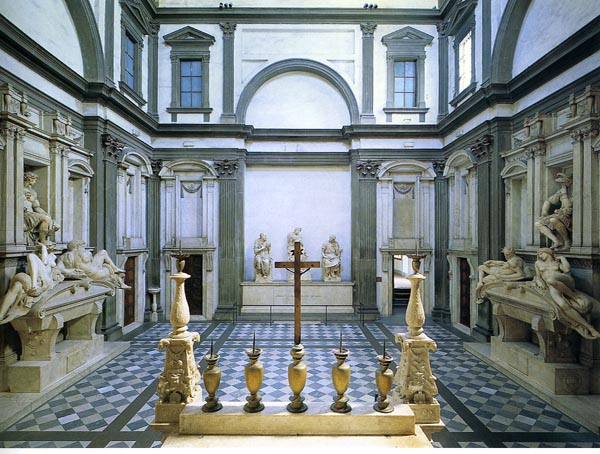
At the Medici Chapels, I found the New Sacristy more striking than I would have if I hadn’t just been overwhelmed by the ornate beauty of the Chapel of Princes.

Before we had climbed very far in Giotto's Tower, I asked, "Are we there yet?" Becca, who was directly in front of me, began to laugh because Alex had asked the same thing just a few moments before.

When we stopped back at the hotel this afternoon, the owner called us “the happy people.”

We ate dinner at a restaurant across the river, which was ridiculously cheap, just as the guidebook promised. A young Italian couple was seated at the opposite end of our table. We think they were laughing at us.

Who knew I liked Botticelli? I love Spring’s face and the way she holds her body.

When I wrote about our trip to West Virginia, I didn’t look at the quick notes I’d jotted down, so I forgot to describe the blueberry bogs as “vermillion.” And I’ve already forgotten what I was going to write down when I got out my notebook on the bus yesterday. I’m so glad I wrote things down in Italy to help me remember.

Pictures from our trip are available here.

Thursday, October 13, 2005

Ctrl+Z

One of my favorite things about fall is the availability of certain goodies--specifically, sweets involving apples, pumpkin, and cinnamon. So once a week, I've been going to the Starbucks across from my office and treating myself to an apple cider and a pumpkin cream cheese muffin. Today, after I had eaten the muffin and was seated at my desk, I looked up the nutritional information for my snack on the Starbucks website. That tasty muffin? Has 470 calories. And 24 grams of fat.

I wish I hadn't looked that up.

Monday, October 10, 2005

Wild, wonderful West Virginia

A couple of years ago, The Husband and I decided we needed to get away. I did a little research online and picked Blackwater Falls State Park in West Virginia. Just after Labor Day, we spent a few days hiking around the park, and other parks in the area. The falls were impressive and the hiking trails along the river were peaceful.

Since the spring I had been planning a trip to Boston for Columbus Day weekend. I’ve never been to Boston and fall seemed like a fine time to head north. But a month ago I realized that The Husband and I both just needed a chance to get out of the city for awhile, so we decided to return to Blackwater, for some peace, quiet, and fall color. Because of a dry summer, the fall color isn’t what it can be, and the falls themselves were not as impressive as they were two years ago. But it doesn’t take much color to impress a couple of California kid like us, and we hardly spent any time at the falls anyhow. The important thing was that the mountain air was cool, it didn’t rain on us as we had expected it to, and it was truly quiet, in a way that we just aren’t used to.

We stayed at the Bright Morning Inn in Davis, which was free of the doilies that covered the B&B I’d chosen on our previous visit. The rooms were simple and the breakfasts were excellent. We spent our evenings at the Purple Fiddle in Thomas, just as we did two years ago, for good food and drink, and excellent live music.

Susan, the owner of the inn, recommended that we spend a day in the Dolly Sods Wilderness Area, which we hadn’t visited on our earlier trip. We took her advice and spent the morning scrambling around on the rocks at Bear Rocks. The red plants you see in the pictures are blueberry bushes. Apparently in July the area is covered with people gathering berries. We missed the berries, but Susan told us that we were lucky to seem them during the few days when the plants are this gorgeous color.

There I am on the rocks at Bear Rocks

blueberry bog

View from Bear Rocks

Later in the day, we hiked the South Prong trail. It was a rocky trail, and quiet—we saw only one other couple. We got to seem some beautiful colors on the trees, and there was another rocky outlook area with beautiful vistas.

South Prong trail

View from South Prong trail

Fall color

Fall color

Before we headed for home this morning, we went to see Blackwater Falls. They were only a trickle compared to two years ago, but they were still beautiful. We also took Susan's advice again and walked out to Lindy Point for lovely views of river canyon.

Blackwater Falls

Blackwater Falls

Blackwater canyon

Blackwater canyon

I'm feeling relaxed now. I've always been able to find peace in looking at the ocean. I'm finding that other landscapes can give me the same kind of perspective. It's hard to feel anything but peace when you're surrounded by scenes like these.

Friday, September 30, 2005

The moon keeps on rising

I reread Prodigal Summer over the summer. It’s my favorite of Barbara Kingsolver’s novels by far. The characters have much more depth than those in her other books. I marvel at her skill for describing landscapes, for making me see a place—she reminds me of Wallace Stegner in that regard, although the styles are very different—and in this book the people are all like landscapes too. I love the way the three stories in the book come together, and I wish I could read the book again for the first time, so I could watch them woven together instead of beginning the book knowing.

But even though it has become a book I know well, different things sometimes catch my attention. I was on the train on my way home from work when, at the bottom of the page, in one of my favorite chapters, I read:

The moon was high now, and smaller, and she felt her grief shrinking with it. Or not shrinking, never really changing, but ceding some of its dominance over the landscape, exactly like the moon.
Those sentences, which I’ve probably read ten times before, seemed to stand out on the page, although I’d never really noticed them before. I read them through several times. The truth in the simile made me catch my breath. Kingsolver describes the moon as having “disentangled itself from the tree branches,” and I think her comparison accurately describe how grief or trauma disentangles itself from one’s life so that a person can go on as they were, yet completely changed. At first the pain of the experience is the defining feature of the landscape—one cannot imagine herself without that pain, and the pain is an important part of who she is. It takes time for the pain to move further away, seeming to shrink, although it is still there, still a part of the landscape of emotions.

I thought of the quote again this morning, as I walked along a quiet street in Georgetown and realized I was happy. I’ve been depressed for the past month, lost in the privacy of grieving. At first my pain was intense—dominating my life, directing all my moods and actions. I don’t know whether the grief disentangled itself from my life, or whether I was the agent and disentangled myself from the grief and depression. Maybe it was simply that I’d given the time to my sorrow that I needed to give in order to heal. Maybe being busy at work with tasks I enjoy had encouraged me to focus on other matters. Maybe it’s the change in the weather. What matters is that sometime in the last few weeks, my depression became that moon that rose higher and higher, becoming only a small part of my personal landscape. It is still there: I don’t believe the things that cause us such deep, personal grief every really leave us, nor do I think they should. But I know that I cannot let that grief dominate my definition of myself for long.

As my grief ceded its dominance over my life, I wasn’t always conscious of the transition. Still, it happened. A few weeks ago I was crying all the time. I had isolated myself from the world around me. I moved slowly, doing only the tasks that were absolutely required of me. Now I have the energy to walk to work instead of taking a bus. Fall is really here, and today I stopped on my way to the office for apple cider and a pumpkin muffin, conscious of the bright blueness of the sky and the way the cool air felt on my hands. And I felt good.

Monday, September 19, 2005

The coolest website ever

...or at least the coolest one I have seen this week. Miss Zoot linked to this, and I think everything I put in is hilarious. I am waiting for The Husband to come upstairs to investigate why I am sitting in the office giggling to myself.

Elizabeth is a newly-discovered breed of fish that's two inches tall! It is twenty feet tall and is bigger on the inside than the outside.

The definition of The Husband's name makes me giggle even more, because I have the sense of humor of a twelve year old. And the definition of my cat's name is perfect (purr-fect?): we've always assumed she would swear a lot if she could speak English.

Hmmmm....I've been wanting a subtitle for this blog. I think I may have found one.

Sunday, September 18, 2005

I heart the internet

I have a counter on this site. I check my stats occasionally, to see how many people are coming in and from where. Usually neither piece of information is very interesting, but yesterday someone came by way of a search on Blogwise. I now know that if you search there for "blow me," my blog is the seventh hit. I am absurdly pleased.

Friday, September 09, 2005

Resurrecting irony

This weekend, on September 11, the Department of Defense will be holding the America Supports You Freedom Walk. According to the walk website, “The America Supports You FREEDOM WALK is an event that allows citizens the opportunity to remember the victims of September 11, honor our American servicemen and women, past and present, and commemorate our freedom.”

I just looked up the definition of commemorate:

1. To honor the memory of with a ceremony.
2. To serve as a memorial to.
Well, this confirms my suspicion that DoD is finally admitting what we liberals have believed for a while now.

Apparently, freedom is dead.

Friday, August 26, 2005

I heart Seattle

Have you ever been to Seattle? Let me tell you something: You need to go to Seattle. Now. I’ll wait. (Okay, I keep seeing that on other blogs. I suppose it works better when you’re sending someone off to another website, rather than an entire city.)

I went to Seattle for work last week. Why did no one tell me how wonderful Seattle is in the summer? Nobody ever mentioned to me this business of warm, sunny, non-humid days in the Pacific Northwest. No wonder Washington and Oregon are being invaded by Californians. Where else are Californians supposed to go? Washington, DC? Let me tell you something: Californians don’t necessarily cope with DC summers. (I promise to stop whining about DC summer in October.) Seattle seems like a much better option.

On Wednesday my boss and I finished work around 3 and headed down to Pike Place Market. As we approached, I admired the view of Puget Sound beyond the buildings. But then I was caught up in the market itself—the rows and rows of flowers, the brightly colored produce, the stink of the fish counters. My boss tried to show me the fish stand where the guys throw the fish, but no one was buying, so there was no need to throw any fish. My favorite thing to look at was a large fish lying on the ice with a sign that said, “Hello! I’m a sturgeon.” My favorite thing to do was taste the free samples—peach-chipotle jam, cherry butter, blueberry syrup, a sweet blackberry. We wandered through the market, looking at the arts and crafts, until it was time to go back and get ready for dinner.

Approaching Pike's Place Market
Boat in Puget Sound behind Pike's Place
Fish market
I'm a sturgeon
Flowers

I went back to the market the next morning. I was meeting my coworkers for breakfast at 7:30. I woke up at 5:30 easily, thanks to the time change. After I got ready, I headed down to the market. There was still no one throwing any fish. I stood for awhile and watched the men shovel ice and lay crabs and fish out on it. They smiled and said hello to me, and went about their work. I wandered through the nearly deserted market, watching people open their produce stands and unload flowers from trucks. When I reached the end of the market, I walked into the original Starbucks and ordered a cup of the thick hot chocolate that reminds me of the month The Husband and I spent traveling in Spain. I took it out to the same place I had been the day before, looking out over the water, and called The Husband at home to tell him what I was up to. A few years before, I called him from San Diego to brag that I was at the beach having fish tacos and margaritas for lunch while he was working. This wasn’t too different.

I went back to the market every day. On Friday we finished work early again. I found a sandwich place at the market for lunch, bought some treats to take home, and went back to my hotel to drop off my purchases and ask how far to Pioneer Square. The concierge gave me a map and assured me that I ought to take a cab. “It’s much too far to walk—at least half an hour.” So, I set out on foot, looking into cute restaurants and shops on my way, and was at Pioneer Square in about 20 minutes. I wandered through Elliott Bay Book Company, enjoying being around books and out of the sun for a few minutes. I bought a lemonade and sat at a shady table on the square reading my book (one I had with me—I was good and didn’t purchase anything new) for awhile before heading back to meet everyone for dinner.

On Saturday my friend Rachel arrived, and we continued to do tourist things. I think she was startled by how early I woke up. I should have prepared her for my East Coast time schedule. We ate lunch at a bagel shop down near the market, then walked to Seattle Center to go to the Experience Music Project. I enjoyed the EMP, although I’m not sure it was worth the $20 cost of admission (I am apparently used to all the free museums in Washington). The Bob Dylan exhibit was excellent—lots of music to listen to, with some context. It was sort of amusing to see letters from Joan Baez and Dylan’s high school yearbook. An old guitar and harmonica belonging to Dylan were displayed, and I thought briefly that it was sad for an instrument to be locked up and not played—probably one of my sillier thoughts for the day. A lot of the exhibit was made up of brief videos, which were fun to watch—I learned a thing or two, heard some good music, and got to see other folk singers that I like. The other exhibits—hip-hop and songwriting—didn’t draw me in in the same way, although some of the interactive stuff in the Sound Lab was fun. I should had here that I was almost disappointed in the ugliness of the building itself. My friend Sara, a native of Washingtonstate, had declared it the ugliest building ever. While it’s certainly not the most attractive building ever, I didn’t find it astoundingly ugly. It was shiny and weirdly shaped and brightly colored. It was not an attractive building, but it was just bizarre. I think there are lots uglier sky scrapers. Here is a view of the EMP from above, taken from the Space Needle, and a close up of one side of the building.

Experience Music Project from above

Close up of one side of the EMP

After the museum, Rachel and I rode the monorail back to the hotel, and learned that the concierge at the hotel is not particularly good at knowing useful information about buses. She was interesting to look at though, with her wrinkly face, dyed blonde hair, animal print glasses frames, and lots of hot pink clothing, lipstick, and nail polish. We figured out the buses ourselves and headed off to see the troll under the bridge and the statue of Lenin. We bought gelato and sorbet and ate on a bench to Lenin’s left.

Troll under a bridge

The largest stature of Lenin in the US
For our last activity of the afternoon, we took advantage of the beautiful, clear day to see the view from the top of the Space Needle. We had beautiful views of Puget Sound and Mt. Rainier. You sort of have to squint at the second photo below to see Mt. Rainier. It was much clearer in real life. I wish I had been able to go up on Thursday, which was even clearer—as we drove along the freeway from interview to interview, I had drooled over the sparkling, sapphire blue of the water. Still, I think we were pretty lucky with the views we got.

View of the Space Needle from Below

View of Puget Sound and Seattle from the Space Needle

View from the Space Needle

I am so totally going back.

Wednesday, August 24, 2005

Name that panda!

You can vote on the name for the National Zoo's baby panda here.

But I prefer this poll. I hope it works and that we get to name it Butterstick. Does anyone know the Chinese word for butter?

Bookworms like me can ramble about books forever

I like books. Not only do I like books, I like to buy books. Part of me feels guilty, thinks that I should save my money, go to the library more often. But I like to own books, to read them, keep them, put them on my own bookshelf so I can reread them later—I do read most novels at least twice. My love of book shopping can be something of a problem. When The Husband and I moved across the country we boxed up our books and mailed them to our new address, so they wouldn’t take up room in the trailer we had hitched to the back of the car. Eight Kinko’s boxes (my sister worked there at the time) arrived at the new apartment a couple of days after we did. Since then, we have bought two more six-foot book cases. I bought a lot of books during grad school, most of which I didn’t sell back at the end of each semester, and once I graduated I began spending money on novels. Mostly I would spend time browsing around used bookstores, where I always seem to spend $20, no matter how many books I buy. But I also purchase from Amazon. Spend $9.48 more and get free shipping? Sure, why not. So during our most recent move, we packed up even more boxes of books, and moved them down the street to our new apartment.

On Sunday, I bought a new book. I was in the Seattle airport, browsing around Borders even though I had two unread books in my bag, because I had a lot of time to kill before my flight, because I knew I would be sitting long enough during the course of the day, and because I can’t resist even an airport bookstore. As I had wandered through Elliott Bay Book Company on Friday afternoon, I had resisted the impulse to buy several interesting books, telling myself that I didn’t need the extra weight in my backpack, that I could easily get the books when I returned to Washington. But now, with the prospect of 8 hours of travel ahead of me, my defenses were down. I tried to recall the books I’d been interested in. The last name of one of the authors had started Ch, I thought, and wandered down to the Cs.

I didn’t find the book, but one name jumped out at me on the third shelf from the floor: Justin Cronin. I knew his name. I had read something by him before. I picked up the book, The Summer Guest. The cover declared him the author of Mary and O’Neill. I looked back down at the shelf, but that book wasn’t there. But that was the book I’d read. I had seen it recommended somewhere, probably the Booksense newsletter, back when I lived in California. I had checked in out of the UCSC library, read it, loved it, and forgotten the name. But I hadn’t forgotten the book. It is a novel told in stories that could stand alone. I remember some of the stories clearly, and I remember a description of snow that seemed perfect to me. I’ve thought about the book several times in the four years or so since I read it, but I always got stuck trying to remember the title or the author.

And so I bought the book and headed back to my gate. I stood in line to board the plane, reading the first few pages, totally hooked. I read the book all the way from Seattle to Phoenix. I read as my second flight took off from Phoenix and as the pilot turned the plane around half an hour later due to mechanical difficulties that were sending us back to the airport to board a different plane. I finished the book sometime just after we passed over Kansas City. I teared up a little, as I often due at the end of books, sad or not, and hoped the man beside me wouldn’t notice.

It was the perfect way to read a book. Well almost—I could have done without the mechanical difficulties, the turbulence that left my tummy upset, the leg cramps, and the lousy customer service of the airline I had chosen. The perfect way would have been to spend an entire day snuggled up with my cat, with good orange juice or ice cream available when I needed a snack, reading the book straight through (which is actually how I read the most recent Harry Potter book). Still, to sit down and read a book all at once, even on a plane, is one of my favorite things. Most of my reading is done on public transit as I travel to and from work. I am happy for the time to read, but the reading isn’t as pleasurable that way—too much stopping and starting, too many distractions. Sometimes I want to stretch a book out, put off finishing it so that I can enjoy it longer, but patience is not one of my virtues, and I find it much more satisfying to read a book from cover to cover. To finish it in a public place isn’t ideal, but it was an airplane at least. I hate reaching the last pages of a book on the bus or train on my way home from work is so much less fun, and I try to race through the pages so I can finish before I read my stop, or interrupt myself every paragraph to glance up to see where I am, which takes away from the pleasure of reading.

I started Isabel Allende’s Portrait in Sepia on Monday, and I haven’t gotten very far at all, because I’ve been reading on public transit, and since it’s cooled off a bit here in DC, I’ve been walking from the metro to the office, rather than taking the bus. I gain exercise, but lose some valuable reading time.

Sunday, August 14, 2005

The pattern

Ann wrote something interesting about destiny and fate that got me thinking.

I don't know if I believe in destiny. Sometimes, when something is distressing me I will try to tell myself that if something is meant to be it will happen. But then I worry about what that does to my beliefs about free will. I do believe that I am free to make my own choices.

In Madeleine L'Engle's A Ring of Endless Light, one of my favorite books, a character wonders about this very thing and the wise grandfather, who says that "the pattern is closely woven," tells him that "Any one of us can cause changes in the pattern by our responses of love or acceptance or resentment."

I find the response soothing, and so long as I don't wonder about whether my responses are predestined, I can keep my head from spinning too much.

I suppose I do believe there is a pattern, or at least I want to.

Tuesday, August 09, 2005

Excuses, excuses....

I did not melt.

It's just that work was eating my brain. And then I went to California, where it was a little hot, but not humid unless you're from Utah, in which case, fine, complain about the humidity in Contra Costa County, but remember that you live in Utah, so you probably have more issues than just humidity. But I was in California, and it was lovely and not humid, and I saw my friend Lynn get married, and she was incredibly beautiful and so was the wedding and I cried because I was so happy. Everyone was happy, and many people were drunk and happy and it also WAS NOT HUMID.

Now I am back in Washington, and it's not too hot, and it's kind of humid, but only because it's raining, because for some reason it insists on raining here in the summer. Note to Californians: if you move to DC and your umbrella breaks in April, don't tell yourself, "Oh, spring is almost over, so I don't need to bother replacing this, because the rainy season is coming to a close, and I can just get a new one in the winter." Because, Californians, the rainy season here NEVER ENDS. But I am adjusting.

Anyhow, I am back, and work is eating my brain once again. Frankly, if work stays like this, I'm going to end up back in grad school, because a disseration would be less stressful. Tomorrow I leave for Iowa, where it will be hot and humid, but this time it's for work, which means I have to wear my grown-up clothes, which will not be at all comfortable in the heat, but I'm not even allowed to whine, because I have to act like a grown up while in my grown up clothes. After Iowa, I get to come home for a few days to complain about the heat and humidity here, and then it's off to Seattle to rejoice in decent, non-muggy weather for almost a week.

So, no, I have not melted. And someday I will come write a real post that is perhaps interesting and has good sentence structure and isn't all whiny.

Monday, July 25, 2005

Repentance

O Weather Gods,
I apologize for all the times I complained that summers in Santa Cruz (and Berkeley and San Francisco) aren't warm enough. I have sinned, but now I realize the the error of my ways. Thank you for using soaring temperatures and high humidity* to show me where I strayed from the path of righteousness.

Now cut it out. I get it already. Amen.


*It is almost 10 pm, and according to weather.com, it's 89 degrees with 80% humidity--putting the heat index at 100 degrees. That's just wrong.

Wednesday, July 20, 2005

Minnesota is so ghetto

For the past two and a half weeks, the bus I take after work from my office to the Metro has been full of teenage ballerinas, here for a summer program with the Washington Ballet. They are very thin, usually wearing shorts and t-shirts over pink tights, with their hair up in buns. For the most part, they are less obnoxious than most groups of teens on the bus.

The dancers come from around the country, and I’ve found their conversations amusing to overhear. I heard one talking about Kansas, and one day a girl who was obviously from New Jersey was teasing a girl from Atlanta about her accent. Last Friday, most were trying to reach their parents by cell phone in an attempt to get permission slips faxed to Washington so that they could attend a Harry Potter midnight release party.

It took willpower to not giggle out loud at the conversation I overheard today. One ballerina sat reading a magazine, and another girl came up and asked her what the article she was reading was about.

“Something about Prairie Home Companion.”

“Prairie Homecoming?”

“No, Prairie Home Companion. The radio show.”

“Oh. On the radio here.”

“No, Minnesota, I think.”

“Oh….Ghetto!”

Friday, July 15, 2005

Ode to Jamie

Yesterday was not my day. I had been complaining that it needed to rain for most of the week. It has been hot and humid, and the rain would break the heat, I thought. There had been occasional thunder, but no actual rain. You know how it feels when you need to sneeze but just can’t? The air had that same sort of tense, waiting need for rain.

Yesterday, it rained.

I was waiting for a bus after work when the first few drops hit. A bus came, and I didn’t even need to get out my umbrella. But by the time we got to the metro station, it was pouring. I opened my umbrella, and tried to move quickly to the metro. By the time I made it into the station, my clothes were pretty wet, in spite of the umbrella.

It was my friend Sara’s birthday, and I was meeting her, her boyfriend Jamie, and some others for a celebratory dinner and a restaurant near my house. On the metro ride home, I decided that I would call Sara and Jamie to ask if they could pick me up on their way to the restaurant. Brian was using the car that night, and normally I would walk, but I didn’t want to go in the rain.

When I came out of the metro, though, the rain had stopped. The air had cooled a bit, and it felt less humid. The ground wasn’t even very wet. I went home and threw my pants in the dryer (yay for having my own dryer!) and found a clean shirt. A little while later, dressed in dry clothes, I headed down to the restaurant, carrying my umbrella, just in case.

I walked quickly down the hill, waving to Marvin the bus driver as his bus lumbered in the opposite direction. When I hit the bottom of the hill, I had to cross over the freeway, on a pedestrian overpass. Just as I started up the ramp, another downpour began. I unfurled my umbrella and quickened my pace. As I started over the freeway, the wind picked up, and a tried to use my umbrella to block the rain coming from my left to no avail. I thought about how embarrassing it was going to be to arrive at the restaurant as wet as I had been when I reached the metro earlier, but as I neared the half-way point of the overpass, I realized I was already much wetter, in spite of being in the rain for under a minute. How did I know I was that much wetter? There was one key reason:

My pants were trying to fall off.

I was completely soaked, and my pants were so heavy with all the water that I was having trouble keeping them up. I folded my useless umbrella, held my pants up with one hand, and ran, wishing I’d worn a belt and wondering what I would do when I reached the restaurant.

I stood underneath the awning when I arrived and looked through the glass front. I could see my reflection in the window. I saw my friends having a drink while they waited for a table. I saw them noticed me and start to smile. I stood there until I saw my friend Jamie heading toward me. I motioned him outside.

“I’ll drive you home to change,” he told me, before I could say much of anything. I refrained from hugging him. No one likes to be hugged by a drowned rat. I gave him my umbrella as we hurried to his car, as any attempt to stay out of the rain seemed a little irrelevant at that point.

At one point in time, Jamie had worried that Brian would be upset with him. That was after Jamie had delivered me home in an inebriated state about three times. We had a pattern: whenever Brian couldn’t go out with the group, or wasn’t in the mood to go out, I would go, drink more than I ought to, and Jamie and Sara would make sure I got home safely. Brian was, of course, never upset with Jamie (and usually not with me, either), but simply glad I had made it home safely. Somehow, in my mind, Jamie driving me home for dry clothes was closely connected to his willingness to be my designated driver. Still, I wished I were drunk rather than soaked.

Jamie waited in the car, listening to the Red Sox game, while I ran into the house to change. I was soaked to the skin, so I shed my clothes in the bathroom and ran to my room. I dressed, and ran down the stairs. I hurried back up to loop a long scarf through my belt loops and knot it, just in case. Within 15 minutes of my first arrival at the restaurant, Jamie and I returned. It was barely raining anymore.

Sara and Jamie dropped me off at home after dinner. I went inside and sat on the couch with the cat in my lap, listening to the messages on the answering machine. The first message made me smile.

“Hey, Elizabeth, it’s Jamie. It’s pouring right now, so if you want a ride to the restaurant, just give me a call on my cell phone and all come pick you up.”

Jamie rocks.

And I am going to try not to wish for rain for the rest of the summer.

Thursday, July 14, 2005

Sashay on the left

One of the cardinal rules of Metro is that you stand on the right on the escalators. There are no signs to explain the rule to anyone unfamiliar with the system, because Metro is afraid that it will encourage more people to walk, which will lead to more people falling, which will lead to lawsuits. So Brian and I coach all of our out of town visitors on this important rule, in hopes of keeping our guests alive when they travel on the trains, especially at rush hour, when the locals are rushing and cranky. When I am stuck behind someone on an escalator, I sometimes excuse myself and try to pass them. One of my friends has been known to yell “Stand on the right” on the escalator at the Smithsonian station, when it was full of tourists standing on both sides. I don’t have the nerve to do that, but sometimes, like this morning, I do want to tell the person ahead of me to sashay on the left.

Last year, Brian and I went to see A Streetcar Named Desire at the Kennedy Center. As we came out of the Foggy Bottom metro there were three women on the escalator. They were standing in a group talking, and two of them were on the left. We weren’t in a hurry for our dinner reservation, and there was no one else around, so we didn’t say anything.

We rode up behind these women. They were older, white, probably in their sixties, and two of them were rather heavy. They wore denim shorts, and they all had some sort of American flag pattern, or at least red, white, and blue—on a shirt, a vest, or a ribbon around a straw hat—almost a uniform of a certain class of DC tourists.

Behind us I heard a loud voice yell, “Stand on the right please.” I actually felt a little bad for the women—even with the “please” the loud voice seemed rude. I turned to look and saw an African-American man, probably around my age, coming up the stairs in long strides. He had extremely dark skin, a shaved head, sunglasses, and was nicely dressed. The women moved to the left.

“Thank you, ladies,” he boomed. “We stand on the right here. If you’re on the left, you have to sashay.” He was either flamingly gay, or did a good impression of it, and he continued past them, chanting, “Sashay. Sashay.” The women began to laugh, and Brian and I did, too. We took the opportunity to pass the women, and we turned in the same direction as the man, toward Washington Circle.

“You got to sashay, ain’t that right, beautiful?” I felt a hand rest on my shoulder for a brief moment. Then he passed us, saying to himself, “Sashay, sashay, sashay.”

Tuesday, July 05, 2005

First date

Among the forgotten things I found in the back of my closet over the weekend was the journal I’d kept in college and just after. I glanced through it, distracting myself from all the chores of moving for half an hour or so. It is primarily a record of the depression I was struggling with and the guys I was dating. Some what I’d written amused me, some of it was embarrassing, and some entries just brought back fond memories.

The most interesting entry was about my first date with Brian. It wasn’t interesting for its own sake—more for the fact that it doesn’t match either Brian’s or my memory of that night. Both of us remember the date being somewhat awkward. I remember him not talking much during dinner. He remembers being nervous, not knowing what to say, and being afraid to look at me because I was wearing a sexy dress, and he was worried about being caught staring (which was really the whole point of the damn dress).

But the day after that date I didn’t write about any nervousness or awkwardness. I wrote about what a good time I had, how comfortable we’d been, how we talked and talked and talked forever over dinner. I can’t say with certainty which is the more accurate description of that evening. I’m inclined to think my memory is correct. Maybe it was just the euphoria of a new relationship that made me write what I did. At the time, that night was apparently absolutely perfect.

Monday, July 04, 2005

Moving

I am in the middle of moving. We’re literally moving just down the street, to another apartment in the same development. I’m excited about the new place—it’s much bigger, it has more “upgrades” than my current unit, and I will have my own washer and dryer, so I no longer will have to constantly bug the supermarket clerks for quarters.

Even though I am glad to be moving, I am not having fun this weekend. I hate the whole process of moving, even though the end result is usually pleasing. I hate having to put my entire life into boxes. I hate all the cleaning. I try to think of it in a more positive light. Even though I hate all the cleaning and sorting involved, it’s good to go through everything and purge things that aren’t necessary, random things I’ve been dragging around during various moves that I really don’t need.

I’ve thrown away a lot of stuff, including about 500 pages of photocopied journal articles I’d used for my senior thesis, and birthday cards in which the senders hadn’t written any notes, just signed their names. There are boxes of things that haven’t been touched since I moved into this apartment three years ago: a box of snapshots and cards and other small things from my wedding, and one of miscellaneous cords, many of which are probably from electronic equipment that’s been tossed.

Yesterday I found a large manila envelope that had slipped behind the shelves in my closet. It was a random collection of stuff:

  • A yellow notepad, mostly used
  • A copy of my senior thesis
  • A photo Christmas card from my half-brother’s family, from several years back
  • A photo of me and my friend Mark at Porter College—taken in July 1998 according to my note on the back
  • A black-and-white photo that my friend Lynn took of me on the carousel at the Boardwalk in 2000
  • A dollar bill
  • Six pennies
  • Print outs of classifieds from the Washington City Paper from my apartment search when I was first moving to Washington
  • A copy of the first issue of the New Yorker to come out after September 11th
  • A hot pink Post-it note: “Call Jeff: B-day 7/22”*

I clearly haven’t looked at this envelope since I left Santa Cruz. Some of it I like—I saved the card, the photos, the magazine. But I’m unclear on how some of it ended up making the move, like the Post-it note (I moved in August, so I didn’t really need the note about Jeff’s birthday at that point) and the ads.

At any rate, the move is taking more time and energy that I’d planned. I’m trying to be philosophical, though, about the whole (miserable) process. Brian has entered some sort of organizational euphoria as he unpacks our kitchen stuff, trying to find a place for everything, repacking things we don’t really use (or that he thinks we don’t need to use) because I won’t actually let him throw away most of it. He repacks it all into carefully labeled boxes that will go up into the attic. I am trying to think of the process of moving in the same way: I will weed out what I don’t need, eliminate things that are no longer necessary, put aside what I am uncertain of, to deal with at some point in the future. I can see some benefits to having a philosophy of life that purges what is unused and organizes everything into carefully labeled boxes. I’m just not sure if it’s an appropriate philosophy for me, personally. And I still hate moving.


*That’s coming right up, isn’t it?. Happy birthday, Jeff!

Friday, July 01, 2005

A chance to sing the song

Warning: There is a very high likelihood that this post will be riddled with clichés.

A friend was visiting last week, and she told us about her new romance. It was sweet to see her so excited and happy. I thought I detected some nervousness there, as well, but that seemed normal, and I decided it was probably part of the excitement.

When she had gone, Brian said to me, “I hope she doesn’t get hurt.” He has said similar things in the past, usually about other female friends who are beginning new relationships, so I wasn’t entirely surprised. But I didn’t quite agree with him.

“She probably will,” I told him. Brian was seemed astonished that I said so—maybe because I am usually the romantic and sentimental one. Still, I thought what I said still qualified as romantic and sentimental.

Another friend used to quote a lyric from a folk song when I was nervous about a new relationship (including my relationship with Brian), and I quoted it right back to him at least once. I was tempted to quote it to Brian right then, but I always feel a little funny offering up wisdom from music, and so I just tried to explain myself.

I told him that she was probably going to get hurt no matter what happens, because she's in love. If the relationship doesn't last, it will be painful since she has already allowed herself to care so much. And if things do work out, the two of them will almost certainly hurt each other, just as Brian and I have. We don't want to hurt each other, and because we are in love we try not to, but it can't be helped. When we cause each other pain, we apologize (because that line from Love Story? It's just wrong. Not that I've ever read the book or seen the movie.) and try to do better.

I feared sounding trite, because I knew I was expressing something of an “it is better to have loved and lost” sentiment. When you love you get hurt. You open yourself up to that. And that’s why being in love is so exciting and so good.

I didn’t say that I hope she does get hurt. That sounds wrong, and it’s not really what I mean. But if you care enough to get hurt, I think that’s probably good for you. That’s romantic. That’s wonderful. And I hope the hurt isn’t too terrible.

Tuesday, June 14, 2005

Tasteless humor

Last night Brian said to me, "You heard that Michael Jackson got off?"

I nodded, and waited a beat for the obvious joke to follow. When Brian didn't say anything more, I couldn't help myself, and I stole the punchline that I had been expecting from him:

"And the jury didn't convict him."

Sunday, June 05, 2005

Judging books by their covers

Who was it that decided one shouldn’t judge a book by its cover? I was in Barnes and Noble yesterday, and I find judging a book by its cover very useful. A certain kind of small, thick book with block letters on the cover and little art is clearly a mystery novel. Add a little art and it’s some kind of popular fiction. Some cover art just says “I am literature, not just fiction.” Pink covers with curly fonts with pictures of high heels and martini glasses scream “chick-lit.” I recognize the covers of books from certain publishers—the orange spines of Penguin books, for instance, or the small Signet Classics—and treat them with varying levels of trust.

Other books are less clear. Most science fiction is easy to recognize—by the title, the font, the cover art. Yesterday I picked up a copy of Flowers for Algernon. It didn’t look like science fiction, but the back cover proclaimed that it was a winner of the Hugo and Nebula awards, which I thought had something to do with sci-fi. I took it over to Brian, who knows more about that genre than I do. He confirmed that it was science fiction, but the kind that I like—I’m resistant to strange names and different planets, but I can handle time travel and futuristic laboratory science. When I was reading The Time Traveler’s Wife and described it to Brian, he said, “You’re reading science fiction?” I was reluctant to describe it as such. “No,” I told him, “it’s just sort of…magic. But treated as real.”

I should admit that I am a book snob. Where a book is in the store and what its cover looks like matters to me. Flowers for Algernon looked interesting. I don’t read much sci-fi, but since it wasn’t in that section (although maybe it was just misfiled, since it didn’t have a black cover with futuristic looking people or creatures on it), I thought it might be worth my attention. But those books with the bright pink or green covers? The one where a cartoonish woman with a high ponytail and high heels holds a martini glass or a shopping bag? That’s chick-lit, and I’m not even going to pick it up to read the back cover. But if a book has a blurry, artsy photo, that’s my book. Blurb from the New Yorker? I’ll take it. A sticker indicating that it’s got Oprah’s approval? Oohh, that’s tough. Some of those books are a little too…Oprah, for my tastes. But then she goes and picks Anna Karenina or The Corrections. What then? And of this is to say that I only read books that are (or aspire to be) “literary fiction.” I look forward to new Patricia Cornwell mysteries. I buy some of those small, fat popular novels. But somehow those aren’t the same for me as the classic books or the new authors I read.

I’m such a snob, that I’m even a bit embarrassed to admit that I was in Barnes and Noble yesterday. I love to look through the books recommended by Booksense. I’d rather say I was in an independent bookstore—Kramerbooks or Chapters. It makes me miss Santa Cruz, where Bookshop Santa Cruz is as big and as comfortable for browsing as Barnes and Noble is. I go to Barnes and Noble, and I buy books on Amazon.com, but I would rather admit to lurking in few, long, narrow aisles of Kulturas, my favorite used book store. That is truly a store for people who love to read—it’s hard to find a specific title, as they don’t know precisely what they have in stock; alphabetical order in approximate (if you are looking for Toni Morrison, start when you first see authors whose names begin with K, and continue until you run into someone whose last name starts with R); and books are two or three deep on the shelves, with more on their sides, stacked on top of those that are lined up neatly. That even makes digging through the mysteries fun, although in my pretentiousness, I tend to wander through the genre-less fiction, picking out books that have been noted by Booksense, or that have those artsy, literary covers. I go there because I like picking up books I've never heard of and those I have, so I can touch them, read the covers or the first chapters, put them back on the shelf, and lose them among other classics and best sellers and obscure titles, while I move on to something else.

Saturday, June 04, 2005

Walking for the Cure

I remember when one of my dearest friends was diagnosed with breast cancer. I was in college, and she sent me an email to tell me. When I went home at Thanksgiving a few weeks later, I tried to make her promise that she would come to my graduation in June. I thought that if I made her promise to be there, she would have to be okay. She wouldn't promise, but she was there (although without much hair) when I received my diploma. And this month she celebrates 5 years since she completed her treatment.

About a month ago I signed up for the Race for the Cure. I was excited about it at the time, and eventually sent out a fundraising email to friends and family. But that was last month, before I went to Italy (photos coming soon) and came back jetlagged.

So last night a sleepy little devil sat on one of my shoulders telling me, "No one will know if you don't go. Just stay home and sleep in."

But a little angel in walking shoes scolded me from my other shoulder, "You said you would do it. People donated $300."

"It's probably going to be raining. You don't want to go downtown at 8 am in the rain," the devil in slippers said.

"Walking 5K in the rain at 8 am is nothing compared to surgery, chemotherapy, and radiation."

How could I argue with that? So this morning I woke up early, headed downtown, and walked 5K, along with thousands of others, included many cancer survivors. And it didn't rain.

Thanks to those of you who gave me donations. That money goes to support valuable research, as well as treatment for those who cannot afford care. And it means a lot to me.

Wednesday, May 18, 2005

Race for the Cure

It's been awhile since I walked to raise money, so when a nice young woman at Whole Foods asked if I would participate in the Komen National Race for the Cure, I said yes. Two women I've known for a very long time, Helen Mehoudar and Anice Nolen, are breast cancer survivors, and I wanted to do this to honor them, as well as to raise money to support breast cancer education, screening, and treatment programs.

Contributions are tax deductible, and you can pledge your support online by clicking here. And if you're in the DC area and want to join me in the walk on June 4th, you can sign up here.

Thank you so much.

Tuesday, May 17, 2005

A politician making sense

I don't normally think of myself as a single-issue voter, but I don't think I could ever vote for someone who wasn't pro-choice. Still, when someone is against abortion, I have some understanding of where they come from. Yes, I could say, "If you don't like abortion, don't have one." But if someone really believes that to have an abortion is killing someone, I can see how they would fight to make abortion illegal. I don't agree with them, but I have some understanding of their position. My real frustration, then, is those who are so opposed to abortion, but are also against comprehensive sex education and improving family leave policies. I think the abortion debate needs to be broadened. It's not just about abortion. There are a lot of other issues, and there are better ways to reduce abortion (it will never be eliminated) than than making it illegal. When I read E.J. Dionne's column today, I thought that Thomas R. Suozzi made a lot of sense.

Monday, May 16, 2005

In which I write about an event that I'm already tired of reading about

Last Wednesday, I attended an all-day meeting at a hotel over by Embassy Row. During lunch, someone came over to the table where I was sitting and mentioned to the group that the White House, Capitol, and Supreme Court were being evacuated. The bearer of the news didn't have any more information than that.

One woman sighed. "I hope whatever's going on is over with before too long. This could really mess up the commute out of the city this evening."

Then we went back to our food and our conversation.

When the meeting resumed after lunch, there was an announcement that everything was fine. We still didn't know what was going on, but it hadn't affected us while it was happening, so it didn't seem worth speculating over now.

I forgot about it until I got home and turned on the computer. My browser opened up to the Washington Post, with news of the small plane that had accidentally ventured into restricted airspace over the District. I had an email from a friend in the midwest, wondering if everything was okay. Was I scared? Had I been evacuated? By that time, I was sure she had the news that everything was fine, so I wrote a quick note back, telling her that we hadn't even really known anything was happening.

I've been wondering if I should write about this at all. I was going to mention how the media overreact to these kinds of things, but after reading nothing except that in the Post for the next couple of days, I'm pretty much tired of it.

I think I'm more interested now in the fact that we don't react. We don't panic. We worry about our commutes and eat our pasta. Most of these things are seen as inconveniences. Last summer, when the terror alert was raised for certain buildings in several cities, buses entering the Pentagon were being stopped. They ran mirrors along to check underneath, and bomb-sniffing dogs were led around the outsides of the buses. I heard rumors that the Pentagon police were even boarding some buses, although it didn't happen on my bus. One of my neighbors was glad they were taking these precautions.* I was upset that my seven-minute bus ride was taking 45 minutes. Add that onto my 5 minute train trip and 2 mile walk to from the metro to the office, and my commute was ridiculously long. I was noticably cranky upon arriving at work that week.

A couple of months ago, as my morning bus made its way to the Pentagon, the driver announced that people weren't being allowed to board trains at the Pentagon Metro. I felt somewhat panicky. After the bombings in Madrid, I began to worry about the terrorism and the Metro.** But none of us displayed any fear. We just concentrated on how we should get to work. The trains were apparently running, just not stopping at the Pentagon, so we got off our bus, and joined all the riders from other buses in the trek back to the previous station. As we passed a HazMat team closing up shop, a Pentagon police officer informed us that we would be allowed to board trains at the Pentagon, and we retraced our steps, and we continued on our normal journey into work.

Even though I'm continuing about my normal business, I am nervous. I worry. In November, in spite of my fear of heights, I climbed the steps to the top of the dome of St. Paul's Cathedral to look out over London. I knew I was safe, but my stomach felt empty, and my knees shook. Back in Washington, I hear that the trains aren't stopping at the Pentagon station and see the flashing lights on the emergency truck, and I have to tell myself not to panic, even as my stomach feels hollow and my knees go a bit wobbly. Then I take a deep breath and head to work. And if it's happening across town, I don't pay much attention at all.


*He works in one of the buildings that had its alert level raised, so he may have just been more nervous than the rest of us in general.

**I'd like to point out here that my main fear isn't that something bad will happen on Metro during my commute. I'm more worried about something happening 30 or 40 minutes after I've exited the system, while Brian's commuting. Because, seriously, if the train I'm on explodes, I'm dead. If the train Brian's on explodes, I'm alone. For me, personally, Plan B there sucks a whole lot more (I am so freakin' eloquent). I haven't decided whether this is selfish or unselfish on my part. And when I mention this to people, they mostly are just surprised that I've thought it through so carefully.

Saturday, May 07, 2005

Have you seen this blogger?

One of my favorite bloggers, Julia Montgomery of Tequila Mockingbird, has disappeared from her blog, and her readers are now staging, as one put it, a six-degrees-of-separation search-and-rescue mission. You can read about the operation, headed up by Postmodern Sass, here.

I started reading her site back in March, just before she left for Thailand. I made my way through her archives, and before too long, I had read every post on her site. Some made me laugh out loud (and when I was reading in my cube at work, that was a little embarrassing), and others made me want to cry. I love her writing. She finally came back on April 1st, with a quick post and some photos, but since then the only updates to the site are the comments on that post (almost 200 now) from readers wondering what has become of her. Selfishly, I want her back so I can read more wonderful stories. Less selfishly, I just want to know that the person I've never met but whom I admire is okay.

So if you find someone meeting this description, could you please let the internet know?

Sunday, May 01, 2005

Weekend getaway

Because I would rather regret my misspent dollars than my misspent youth, and because a weekend of my youth is surely more misspent doing laundry and grocery shopping than sightseeing in a foreign city, last week I went to Buenos Aires for the weekend. I am quite pleased with myself, even if I do feel a wee bit silly. But Brian was in São Paulo this past week for work, and he figured he might as well spend the weekend before in Argentina. I certainly wasn't going to let him go have fun with out me; I'm certain there was something about that in the vows. So on Friday night we headed to Argentina.

*****

One of the biggest problems we faced in Argentina was the language barrier. Both of us took Spanish in college, but it’s been a good five years since we’ve had any lessons, and four since we’ve had much occasion to use it. Add to our inexperience, the fact that the Argentine accent was stronger than we’d expected. One of our college Spanish teachers was from Argentina, so we had some idea of what the language would sound like, but Carlos must have controlled his accent to help us learn what Spanish sounds like in the States, Mexico, and everywhere else. I wasn’t too worried about language issues when we first arrived. A week earlier, I had called to reserve a room. I was able to understand and answer all the questions the man asked me: How many people? When will you arrive? How many nights?

We arrived at the airport early Saturday morning, and I approached the first counter marked “Remises” to find out about a taxi to our hotel.

“¿Cuánto cuesta un remis a la Calle Lavalle?” I asked, hoping they would understand me. I had no idea whether ‘remis’ was masculine or feminine, and I pronounced ‘all’ as ‘eye.’

“¿A Cah-shay Lah-vah-shay?” The woman asked after a moment.

Brian and I exchanged a glance that communicated all kinds of questions and worries. “Sí,” I replied.

*****

One in a cab, the driver asked us where we were going more specifically, and I checked the address in Lonely Planet. When we were stopped at a toll plaza, the driver asked to see the listing. I showed him, and he said something I didn’t understand. I looked at Brian, hoping he had gotten it.

“He says our hotel burned down.”

I understood that the man was offering to take us to a different hotel, run by someone he knew. Eighty pesos a night, including breakfast, he told us. Any trust I had for the man flew out the car window and was run over by some other little car on the highway into Buenos Aires. I had read posts in the Thorn Tree forum about taxi drivers in this city. They weren’t to be trusted very much anyhow. While Brian and the driver stumbled through conversations about other topics, I concentrated on figuring out how to say “I don’t believe you,” and “Let me out of this car.”

As we approached Lavalle, the driver again repeated what he had told us earlier about the hotel. I told Brian that we needed to just go to the hotel and work things out from there if there was really a problem. Brian conveyed this to the driver, and slowly started to figure out that the hotel had not burned down; that wasn’t what the driver had been telling us after all. He’d only meant the hotel was likely to be full.

“Tenemos reservaciones,” I told him, confident enough to say that. And I still had some 'reservaciones' about this driver. We declined his offer to wait for us, in case the hotel was full, and headed along the pedestrian mall to the hotel.

When we got to our room, we got out our Spanish-English dictionary. The words for ‘flame’ and ‘full’ are rather similar. Brian had simply heard one when the driver had said the other. Having figured out that, we contemplated the sign in our room:

Sr. Pasajero:
Tome nota que su equipaje puede ser revisado cuando usted retira del hotel.
-La Gerencia

Did it mean they would search our bags when we went out? Or that we could check them at the desk when we checked out if we wanted to continue sight-seeing.

“I guess your interpretation depends on how paranoid you are,” Brian said. He went to take a shower, while I turned on the TV. I heard the water start to run, and then he came back into the room.

“I’m watching Argentine cartoons,” I told him.

“This is important.”

“There’s a guy in a turban. I think he’s the bad guy.”

“No, listen. ‘C’ stands for ‘caliente,’ not ‘cold.’”

Very important indeed.

*****

Later on we checked to see if the water drained the wrong way in the Southern Hemisphere. The toilet didn’t seem like a good way to tell, and we couldn’t quite see which way the water was funneling down the drain in the sink, so I spit in some toothpaste while I was brushing my teeth. It swirled counter-clockwise down the drain.

When I first brushed my teeth after returning home, I watched the water swirl down the drain. Counter-clockwise. I did some research with my most trusted source for random information. It turns out, the water should have drained clockwise when we were in Argentina, but that we needed to let the water rest for a long time before we would see the effect.

*****

So what did we actually see in Argentina? It’s amazing what one can pack into two days. We started out wandering along Florida Street, a pedestrian mall of shops, to the Plaza de Mayo.

One of the first things that we saw was tango dancers on the street, as we’d been promised.

Photo of tango dancers

They were amazing. Later, we saw a sign describing tango as “the vertical expression of a horizontal desire,” and that was the honest-to-goodness truth: watching tango is like watching people have sex standing up in public.

Plaza de Mayo was mostly empty, as it was the weekend. We saw the monument there to the revolution and independence of Argentina, and lots of graffiti. The Casa Rosada is there—the government building that houses the executive power (basically like our White House). That’s where you saw Madonna sing from the balcony in Evita.

Photo of La Plaza de Mayo

There is also an interesting cathedral lining the plaza. Outside of the cathedral we saw a camera crew and some trucks, which we’d also seen as we walked along Florida. We watched them for awhile and couldn’t figure out what they were doing.

From there we made our way toward Recoleta, to the cemetery that everyone told us we needed to see. It was the strangest cemetery I had ever seen. Outside there were musicians playing, and a sort of crafts fair was going on. There were more tango dancers. I had expected something a long the lines of Arlington Cemetery, with a series of graves and grave markers and the occasional larger memorial. But all of the tombs at Recoleta are above ground, and it looks like a small city.

Photo of tombs in el cementario recoleta

We peered into the tombs. Sometimes there was a casket right there. More often there was some sort of altar with a crucifix, and a steep, narrow staircase descending into the ground. We finally located Eva Perón’s tomb, where she is buried with her family (Juan Perón is in another cemetery across town), mostly by following the crowds.

Photo of Duarte family tomb

Photo of plaque for Evita

We awoke the next morning to the sound of rain. I dragged a very cranky Brian out in the wet, chilly morning, to look at old buildings, including el Teatro Colon (the opera house), and el Palacio del Congreso (the capitol building).

Photo of el Teatro Colon

Photo of el Palacio del Congreso

Finally Brian convinced me to stop in a café, where he ordered coffee and we had hot, fresh, delicious empanadas. We bought a newspaper, and I read that the camera crew outside the cathedral had been a Spike Lee crew filming some sort of commericial. By the time we were finished, it was still chilly, but the rain had stopped, and Brian had enough caffeine in him to make him a much happier sight-seeing companion.

The highlight of that second day was the San Telmo market. Much like Washington’s Eastern Market, the Mercado San Telmo is in an enclosed area, where there are produce stands and stands to buy meat, cheese, eggs, and bread. But there are also antiques booths, with people selling delicate-looking old toys, old-fashioned cameras, and gaudy jewelry. Outside the market, other people set up booths to sell crafts and other goods.

Photo of the outside of El Mercado San Telmo

Photo of a produce stand

Photo of meat

We went from San Telmo to Caminito in La Boca. Caminito, which is named after a tango song, is a very touristy, pedestrian strip down near the waterfront. The buildings are painted bright colors.

Photo of Caminito

Photo of Caminito

I had read that it wasn’t really safe to wander off the main streets in La Boca, but I found it interesting how poor the neighborhood surrounding Caminito was. There was a soccer game about to start in the stadium nearby, and the streets near Caminito were filled with people dressed in blue and yellow, many of them wrapped in their team’s flag, as they walked to the game.

People were obsessed with soccer. On our way back to our downtown hotel, we passed a bus stop that was outside a café. As we approached, we noticed half a dozen men with their faces pressed up against the glass. I couldn’t figure out what they were doing at first, but then we saw that the game had started and was being shown on television in the café. The men were watching it intently.

That game (or maybe another) was on the radio on the bus I took to the airport later that night. The three other passengers on the bus gathered up front near the driver, listening to the game. I let my mind wander as I watched the city float by the window in the darkness. The announcer spoke too rapidly for me to understand anything except his call of “¡GOOOOOOOOLLLLLLLL!” when someone scored.